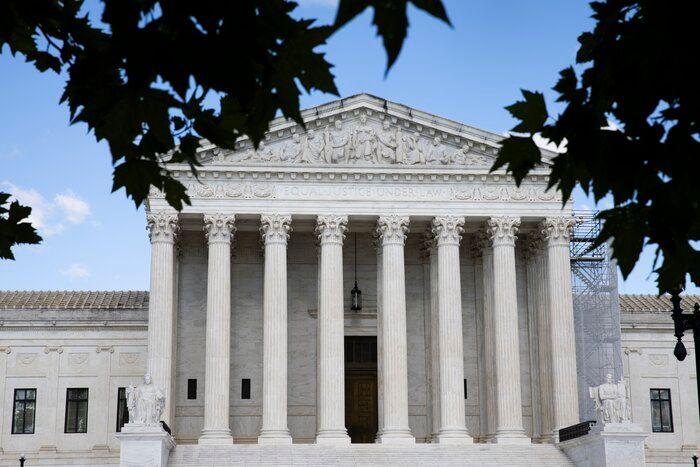
Several U.S. Supreme Court justices asked the government to defend why well-established judicial doctrines shouldn't limit President Donald Trump's tariffs imposed under the International Emergency Economic Powers Act during oral arguments Wednesday, casting doubt on whether they believe the law provides that kind of authority.
Chief Justice John Roberts told the solicitor general that the major questions doctrine "might be directly applicable" to the case, despite the government's arguments against that idea. (Aashish Kiphayet/NurPhoto via AP)
Chief Justice John Roberts told U.S. Solicitor General D. John Sauer that the major questions doctrine, which generally says large-scale regulatory initiatives that have broad effects can't be grounded in vague, minor or obscure provisions of law without clear congressional authorization, "might be directly applicable" to the case, despite the government's arguments against that idea.
IEEPA, enacted in 1977, authorizes the president to regulate imports "to deal with any unusual and extraordinary threat" to national security, foreign policy or the economy. The government has argued that the words "regulate importation" in IEEPA include the power to impose open-ended tariffs of any rate at Trump's discretion.
However, "the justification is being used for a power to impose tariffs on any product from any country in any amount, for any length of time," Justice Roberts said. "That seems like, I'm not suggesting it's not there, but it does seem like that's major authority, and the basis for the claim seems to be a misfit."
Sauer told the justices that the major questions doctrine cannot apply to Trump's tariffs because they are regulatory in nature and address matters in a foreign affairs context, where the president is given significant deference under his Article II powers. Furthermore, IEEPA prescribes the president "major powers to address major problems" in foreign affairs that should satisfy any concerns over the doctrine, Sauer said.
Sauer said that "regulate importation" as included in IEEPA should be determined to include the power to impose tariffs as "a core application" of the phrase. That authority fits within the power to regulate foreign commerce, not the constitutional Article I power to tax and impose duties in raising revenue, Sauer argued.
Questions presented in Learning Resources v. Trump / Trump v. V.O.S. Selections
Whether the International Emergency Economic Powers Act authorizes the president to impose tariffs and, if so, whether IEEPA unconstitutionally delegates legislative authority to the president.
"For that reason, we are squarely within the tradition that I was talking about before of very broad, historically very broad, delegations of the power to regulate foreign commerce to the president, because he has inherent Article II authority in the area of foreign affairs," he said.
But Justice Sonia Sotomayor was skeptical of the idea that tariffs could be separated from their inherent revenue-raising functionality to be considered separate "regulatory tariffs" like import quotas, as Sauer described.
"You want to say tariffs are not taxes, but that's exactly what they are," Justice Sotomayor said. "They're generating money from American citizens: revenue. You say it's incidental to the regulatory purpose, but I don't see how a quota is equivalent to revenue. Raising a quota sets a limit to what you can import in, but it doesn't generate revenue."
Justice Sotomayor acknowledged that the major questions doctrine has never been applied in a matter involving presidential discretion in the foreign affairs arena, but she reiterated that the tariffs are "a tax."
In response to Justice Amy Comey Barrett, Sauer was unable to identify a statute beyond IEEPA and its predecessor law, the Trading With the Enemy Act, where the phrase "regulate importation" had been interpreted to mean the ability to impose tariffs.
Several justices, including Justice Neil Gorsuch, focused on the nondelegation doctrine, which prevents Congress from delegating its constitutional legislative powers to the executive branch.
Justice Gorsuch said that if he were to follow Sauer and the government's logic, Congress could seemingly abdicate more of its constitutional authority to the executive branch without nondelegation concerns.
"Could Congress delegate to the president the power to regulate commerce with foreign nations as he sees fit and collect duties as he sees fit?" Justice Gorsuch asked. "What would prohibit Congress from just abdicating all responsibility to regulate foreign commerce, [or,] for that matter, declare war, to the president?"
Sauer acknowledged that there could be "very limited, very, very deferential" applications of the nondelegation and major questions doctrines in the case, but said those should be heavily skewed in Trump's favor given the deference to the executive branch in the foreign affairs context.
But Justice Gorsuch also said that there lies a separation of powers "retrieval problem" with the government's arguments that IEEPA authorizes unbound and unilateral tariff actions.
"What president's ever going to give that power back?" Justice Gorsuch said. "Pretty rare president. How should that inform our view of delegations and major questions?"
At the Supreme Court, the government is looking to reverse a Federal Circuit ruling in August that largely affirmed a U.S. Court of International Trade judgment deeming certain tariffs under IEEPA unlawful, in a consolidated case challenging the tariffs raised by several small businesses led by V.O.S. Selections Inc. and a dozen states. The government is also arguing that the CIT is the proper venue — as opposed to the federal district courts — for matters involving tariffs imposed under IEEPA in a case brought by Illinois-based toymakers Learning Resources Inc. and hand2mind Inc.
The toymakers were awaiting oral arguments at the D.C. Circuit following a D.C. federal court determining that IEEPA doesn't allow any tariffs when the justices decided to consider their case before judgment with the government's appeal to the Federal Circuit ruling.
The parties challenged the tariffs placed worldwide as part of a national emergency Trump declared under IEEPA in April over persistent U.S. trade deficits. The parties have also challenged another set of tariffs under IEEPA on Chinese, Mexican and Canadian goods in response to a national emergency declared over illegal fentanyl entering the U.S.
Neal Katyal of Milbank LLP, arguing on behalf of the small businesses and toymakers challenging the tariffs, told the justices that tariffs "are first and foremost ways of regulating revenue" and are constitutionally treated separately from other means to regulate foreign commerce.
"There's a category shift between a tariff and the other eight powers in IEEPA because it is revenue-raising," Katyal said.
In addition, the statutory language in IEEPA fails to mention any words to define raising revenue or authorizing monetary exactions, Katyal said. He added that the government's position amounts to "an open-ended power to junk the tariff laws."
Justice Roberts asked Katyal to explain how to view the influence that Trump's tariffs have had in reaching framework trade deals with other countries.
"When you say, 'Well, this is a tax, [this is] Congress' power,' it implicates very directly the president's foreign affairs power," Justice Roberts said.
Katyal responded that a better way to view the case is through a constitutional lens, rather than in terms of foreign influence.
"Instead of thinking about foreign versus domestic, the better way of thinking about it is Article I versus Article II, and as my friend [Sauer] finally conceded to Justice Gorsuch, there is no Article II power here, at least when we're talking about peacetime."
Justice Gorsuch had asked Sauer about cases where presidents have taken tariff-like actions during wartime, though Sauer emphasized that the government is not contesting that kind of potential control over tariffs during peacetime.
Several justices, including Justices Gorsuch and Barrett, also inquired about the differences between licenses, which are explicitly mentioned in IEEPA, and licensing fees and tariffs, both of which aren't mentioned in the law. While they may have similar effect economically, Katyal and counsel for the states challenging the tariffs said, they contended licenses are different from tariffs.
IEEPA has never been used to impose a fee associated with a licensing regime, according to Benjamin Gutman, Oregon's solicitor general, who argued on behalf of the dozen states challenging the tariffs.
"This is a statute [where] licenses can be used. For example, the president might ban certain transactions with a foreign country, but then grant licenses to do them for humanitarian reasons," Gutman said. "But, as far as I'm aware, there's never been a fee charged for that."
Further, IEEPA is about giving the president the authority to control foreign commerce in national emergencies, while tariffs "cede control over whether the transaction occurs from the government to the individuals engaging in the transaction," Gutman said.
The toymakers are represented by Pratik A. Shah, James E. Tysse, Matthew R. Nicely, Daniel M. Witkowski, Kristen E. Loveland and Margaret O. Rusconi of Akin Gump Strauss Hauer & Feld LLP.
The businesses are represented by Neal Kumar Katyal, Colleen E. Roh Sinzdak, Ezra P. Louvis and Samantha K. Ilagan of Milbank LLP, Michael W. McConnell, Steffen N. Johnson and Paul N. Harold of Wilson Sonsini Goodrich & Rosati PC, Jeffrey M. Schwab, Reilly Stephens and James McQuaid of the Liberty Justice Center, and Ilya Somin of George Mason University's Antonin Scalia Law School.
The states are represented by their respective attorneys general.
The government is represented by D. John Sauer, Brett A. Shumate, Sarah M. Harris, Sopan Joshi, Mark R. Freeman, Michael S. Raab, Brad Hinshelwood, Daniel Winik and Sophia Shams of the U.S. Department of Justice's Civil Division.
The cases are Learning Resources Inc. et al. v. Trump et al., case number 24-1287, and Trump et al. v. V.O.S. Selections Inc. et al., case number 25-250, in the Supreme Court of the United States.

Nov 5




 Deal Summary